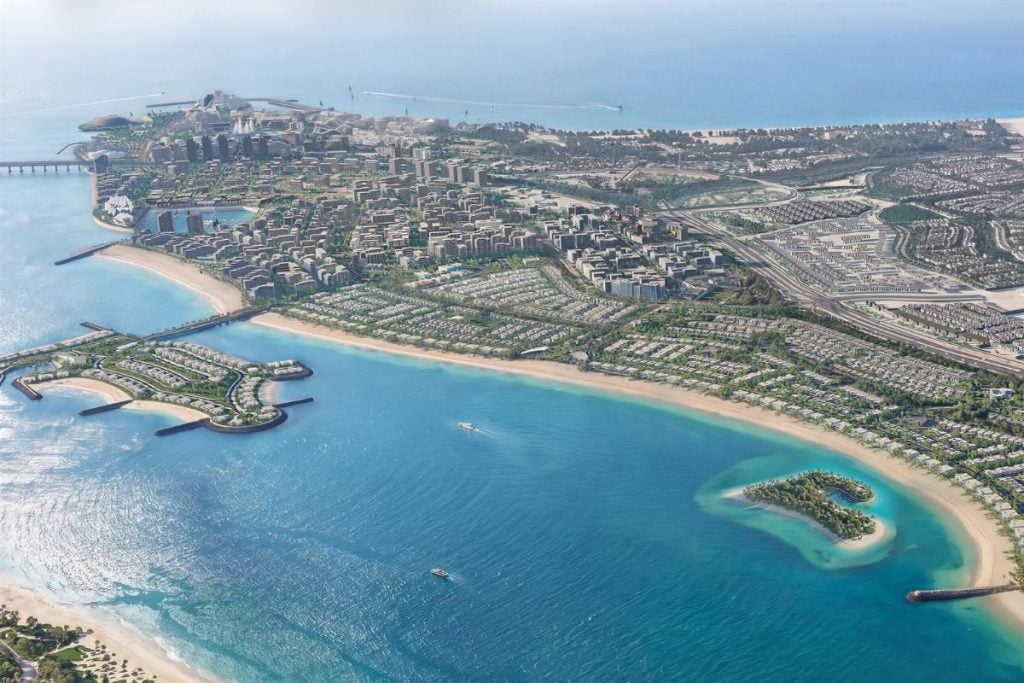
On 22 July 2026, Aldar unveiled Marsa Al Saadiyat, a 6.4 million square metre district on Saadiyat Island in Abu Dhabi. The announced development value reaches AED 100 billion, and the programme is designed to house more than 58,000 residents.
One month earlier, on 25 June, construction of Dar al Funoon had begun within the same perimeter. This performing-arts venue of more than 6,000 seats, designed by Frank Gehry’s practice, will open in 2030.
The first residential sales are announced for the second half of 2026. Here is what the project contains, what it changes for Saadiyat, and what to look at before taking a position in a first phase.
What does the Marsa Al Saadiyat masterplan contain?
The project occupies 8 kilometres of coastline, including 5.6 kilometres of beaches. It is organised around a marina that will become the largest in the emirate.
The components announced by Aldar:
Residential · Villas, waterfront apartments, branded residences and private mansions, for more than 58,000 residents at maturity.
Marina · More than 350 berths, the largest capacity in Abu Dhabi, sized for large vessels.
Hospitality and amenities · Two luxury hotels, three schools, retail and dining along the waterfront.
Soft mobility · 140 kilometres of pedestrian promenades and 46 kilometres of cycle paths.
Culture · Dar al Funoon, a performing-arts venue of more than 6,000 seats, set within the project perimeter.
Timeline · Infrastructure works in the third quarter of 2026, first residential sales in the second half.
The timeline is tight for a scheme of this size. Buying in the first phase means buying at the launch price, with the widest choice of units and payments staged during construction. You take a position before the district has taken shape, on an asset whose value tracks the progress of the works and the arrival of the amenities. What remains to be established is which phase the proposed unit sits in and what will be built around it. That is where the essential lies, and we return to it below.
What Dar al Funoon brings to Saadiyat
Dar al Funoon is led by Abu Dhabi’s Department of Culture and Tourism. The complex will open in 2030 and bring together four halls: a main auditorium of more than 2,000 seats, an open-air amphitheatre of 3,500 seats, a studio theatre of 400 seats and a jazz club of 250 seats.
Its location matters as much as its size. The venue sits inside the Marsa Al Saadiyat perimeter, of which it will be the cultural anchor. Future residents of the district will therefore live a few minutes’ walk from a year-round programme.
It joins a concentration of institutions rare on a global scale, gathered within a few kilometres: the Louvre Abu Dhabi, the Zayed National Museum opened in December 2025, the Natural History Museum, teamLab Phenomena, and the Guggenheim Abu Dhabi, whose opening is set for 11 December 2026.
Why this matters to an investor
A district that gathers an emirate’s cultural institutions draws visitors all year round, not by season. Marsa Al Saadiyat adds the residential component that this cultural offer was missing.
What we know about the district, and what we do not yet know
The AED 100 billion figure is often misread, and it is worth clarifying before going further.
What the figure actually covers
The AED 100 billion represents the development value of the entire masterplan, over its full lifespan. It is not the budget of a first tranche. Aldar has not published a phasing schedule, but a project of this size is usually built over more than ten years.
You therefore need to be clear about what you are buying at this stage. The land is bare today. You are buying a location on a plan, in a district that does not yet exist, and that plan will keep evolving throughout construction. The renderings shown at launch convey Aldar’s intent, not the final state of the site. What will be built next to your building, at what height, with which amenities and by what date, will become clearer phase by phase.
A mechanical effect also applies: the later a tranche is launched, the further off its delivery. The final phases of a scheme of this size will come out of the ground well after the first ones. A unit bought in the first phase and a unit bought five years later share neither the same horizon nor the same environment at the moment of handover.
None of this is an obstacle: it is how a planned community normally works, and it is also what allows you to enter at the launch price. But you do not buy here the way you buy an apartment in a standalone tower. You buy a position within an overall structure, and you need to understand that structure before choosing your own.
Should you target Saadiyat rather than Dubai?
The two markets offer neither the same depth nor the same logic, and the comparison rests on precise criteria.
| Criterion | Dubai | Saadiyat, Abu Dhabi |
|---|---|---|
| Market depth | High volumes, liquid resale | Developing market, wealth-preservation horizon |
| Demand driver | International flows and momentum | Public and cultural institutions |
| Data history | Long and well documented | More recent on the residential segment |
| Investor profile | Rental yield, faster rotation | Wealth diversification, high end |
Saadiyat is for the investor seeking a rare location and thinking on a ten-year horizon. The district’s appeal rests on the presence of the emirate’s major cultural institutions, already open or committed. For a first acquisition geared to immediate yield, Dubai remains the natural ground and we point our clients there without hesitation. To diversify a portfolio, Saadiyat deserves a place in the thinking.
How to approach the first phase of sales
The first phase deserves your attention for two reasons. It sets the price reference against which later tranches will be calibrated, and it carries the locations already fixed on the overall plan, those whose aspect and view are known.
Four parameters then account for most of the gap between two acquisitions in the same programme.
- The choice of unit Floor, orientation, aspect and position within the district determine the resale value gap, often more than the price quoted at launch.
- Price relative to the district Recent transactions at Saadiyat Beach, Saadiyat Grove and Mamsha Al Saadiyat provide a per-square-foot reference on already-delivered assets. That is the only serious point of comparison.
- The payment plan The staging during construction and the share due on handover change the capital actually committed. Two units at the same price do not demand the same effort.
- The chosen tranche It determines both the handover date of your property and the state of the district when you receive the keys.
One point deserves to be recalled, because it reassures for good reason. In the UAE, sale contracts are largely standardised and overseen by the local authorities, with protective mechanisms such as escrow accounts. The quality of an acquisition is therefore not decided in the contract clauses, but in the four parameters above.
How to prepare before sales open
On a project of this nature, the difficulty lies neither in the contract, which is standardised, nor in the developer’s soundness, which is established. It lies in the choice of phase, in the position within the overall plan and in the moment you enter.
These three questions are worked out before sales open. Once a tranche is launched, the best positions go quickly and there is little time left to compare.
At Innvesta, based in the UAE and founded by three French entrepreneurs, we have followed these launches phase by phase for several years. We have seen how these planned communities fill up, and we share that reading with our clients before they commit. Some projects are worth a position the moment they open, others are worth waiting for the next tranche.
Where Marsa Al Saadiyat sits in that reading, and which phase looks most compelling to us, is exactly what we discuss with the investors who write to us.
Acquisition is open to foreign nationals in Abu Dhabi’s investment zones, of which Saadiyat is one, and can grant eligibility for a residency visa depending on the amount committed. We set out these mechanisms in our guide to residency visas for investors.
Request our analysis of the project
We follow the marketing of Marsa Al Saadiyat phase by phase. To learn where the project sits in our reading and which tranche looks most compelling to us, write to us.
Frequently asked questions
When will it be possible to buy at Marsa Al Saadiyat?
Aldar has announced the first residential sales for the second half of 2026 and infrastructure works for the third quarter. Further phases will follow, as a masterplan of this size is marketed in successive tranches over several years.
What is Dar al Funoon?
A performing-arts institution of more than 6,000 seats across four halls, designed by Frank Gehry’s practice and led by Abu Dhabi’s Department of Culture and Tourism. It is due to open in 2030.
How are the two projects connected?
Dar al Funoon sits inside the Marsa Al Saadiyat perimeter and will act as its cultural anchor. Both announcements are part of the same movement, one month apart.
Can a foreign national buy on Saadiyat?
Yes. Saadiyat is one of Abu Dhabi’s investment zones open to foreign ownership, and an acquisition can grant eligibility for a residency visa depending on the thresholds in force.
Should you buy in the very first phase?
It depends on the project and the position on offer. The first phase sets the price reference and carries the best-defined locations, but not all tranches are equal. Write to us to hear our read on Marsa Al Saadiyat.
How should you prepare before the first phase?
By gathering the district’s comparable transactions and studying the neighbouring developments before the tranche opens. We follow these launches phase by phase: request our analysis of Marsa Al Saadiyat.
Sources
Sources: Aldar Properties, Abu Dhabi Media Office, Department of Culture and Tourism, Gulf News, Gulf Business, The National.